

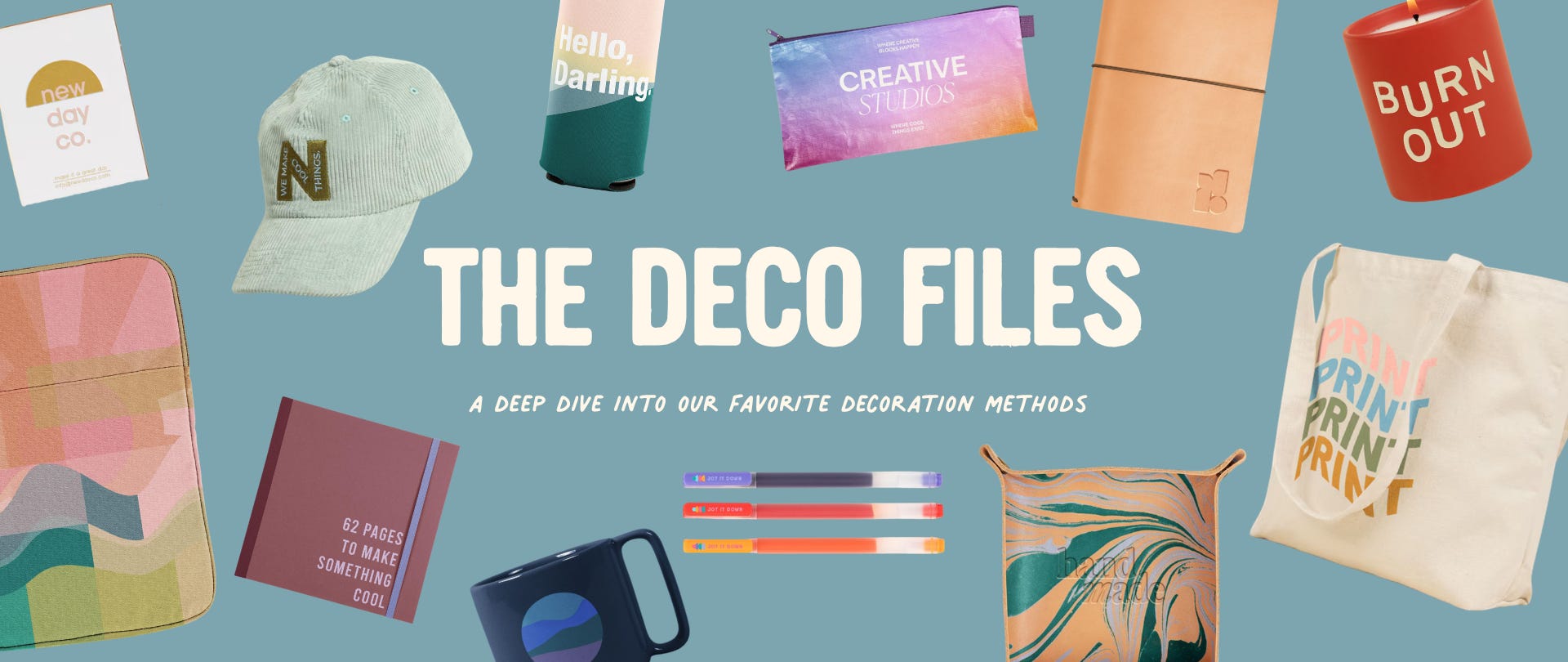
Welcome to The Deco Files. We are breaking down some of our favorite decoration methods so you know exactly what you are looking at, what it takes to pull it off, and when it is the right fit.
We started this series with screen printing, the one everybody already knew, ink sitting on top of a smooth surface, no fuss. Twelve posts later we’d covered everything from ink that soaks into fibers to thread stitched in instead of printed on to floating pigment on water to marble leather, and leather marbling closed it out.
Here’s the whole series in one place, grouped by material, with each post’s cheat-sheet formula so you can skim and go.
Fabric and soft goods
→ Sublimation dyes color directly into the fibers of white or light poly fabrics (4CP Poly, Ripstop, 4CP Nylon, 4CP Neoprene, Sublimated Drinkware), so it nails photographic detail and gradients with zero added hand feel. Take a deeper look ⤵

→ Direct to Fabric UV is sublimation’s cousin for the specialty fabrics sublimation can’t touch (Softek, Duratek, Vegan Leather), printing full 4-color artwork onto coated or engineered surfaces and curing it instantly under UV light. Take a deeper look ⤵

→ Embroidery skips ink entirely and stitches the design straight into the product, which is why it reads classic and premium and outlasts almost everything else on this list. Lives on Hats, Canvas Bags & Totes, Corduroy Bags & Totes, Cloud Quilted Nylon Bags & Pouches, and Jute Totes. Take a deeper look ⤵

→ Pigment-Dyed Digital is the soft, washed-in, “I’ve had this forever” look, printed onto 100% cotton canvas and heat-set so the color bonds with the fiber instead of stiffening on top, with a lower water footprint than traditional pigment-dye methods. Take a deeper look ⤵

Hard goods and drinkware
→ UV Inkjet sprays full-color ink directly onto a hard surface and cures it instantly, the default for pens, lanyard sliders, drinkware, and electronics with detail worth protecting (Pens, Sliders on Rope Rope, Drinkware, Hydrosteel Water Bottles, Pen Bar Boxes).

→ Decal on Drinkware prints onto a transfer first, then heat-sets it permanently onto ceramic, enamel, or glass, so busy multi-color logos survive years of actual use. Lives on Ceramic Drinkware & Candles and Glass Drinkware & Candles.

→ Laser Etching burns the design straight into a hard surface (metal hardware like Leather Key Fobs and Gomi Charging Cables), so the mark is part of the product with nothing left to fade, crack, or peel.

→ Sand Carving blasts pressurized sand through a stencil to etch a frosted, recessed mark into glass or ceramic, the kind of texture that makes a piece feel like a gift instead of a giveaway. Lives on Ceramic Drinkware, Ceramic Candles, and Glass Drinkware.

Paper
→ Paper Printing runs Offset Digital ink straight onto paper stock for inserts, gift boxes, and candle labels, the stuff that makes a product feel planned instead of assembled. Lives on Paper Goods, Gift Boxes, and Candle Labels.

→ Letterpress presses an inked plate directly into paper stock, so the decoration and the paper become the same thing, and the slight piece-to-piece variation is the appeal, not a flaw.

Leather
→ Debossing uses pressure and a custom die to recess the design into leather, no ink, no thread, just a quiet, tactile mark that ages right alongside the leather around it.

→ Leather Marbling hand-floats pigment on water and transfers it onto leather, so every piece comes out genuinely different on purpose, available alongside debossing for a marbled field plus a branded mark on the same piece.

And that’s a wrap
Twelve methods, all documented, and this post is your reference from here on out. Next time a client asks why their tote can’t be sublimated or what the difference between debossing and laser etching actually is, this is the one you come back to.
And since we just spent all this time on how things get decorated, it felt like the right moment to pivot to what they’re made of, so next up we’re going into materials, which is its own rabbit hole in the best possible way. See you soon!
That’s a wrap on the Deco Files. Save this one, it’s the whole syllabus.